
Civic Poll 2025 - perception of CSOs
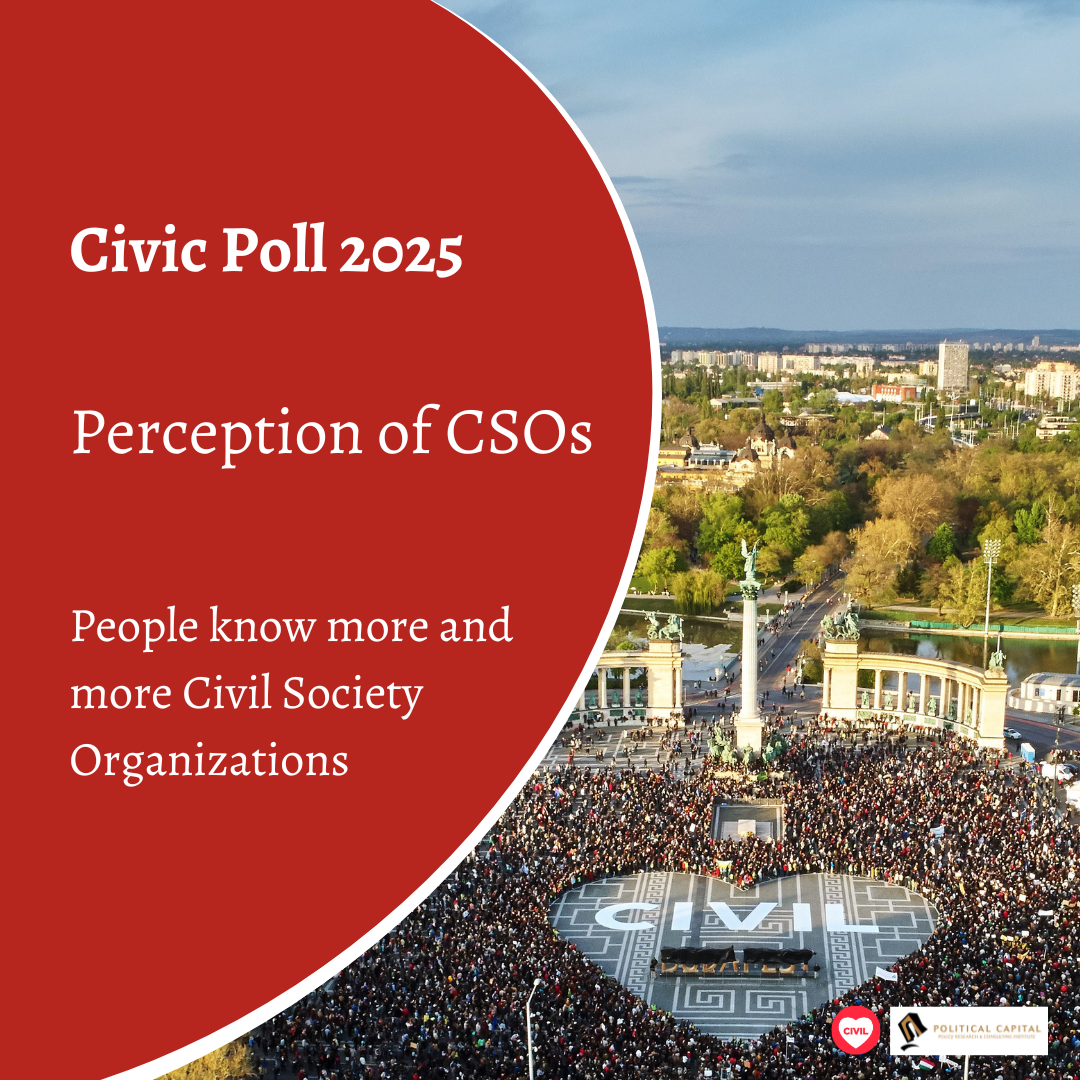
The majority of Hungarians consider the work of civil society organizations important, and are familiar with an increasing number of such organizations.
There is also a high propensity to give support them —according to the latest representative survey by Civilizáció and Political Capital. At the same time, polarization has not spared public opinion regarding the civil society sector.
Civilizáció and Political Capital have conducted their fourth survey on public opinion regarding CSO’s. Some of our questions were included in the previous studies as well, but other questions were modified, or omitted and new questions were added based on our past experiences. The survey was conducted by Závecz Research in 2025, between November 23 and 31, using a so-called hybrid data collection method that combined telephone interviews with online interviews. The survey was based on a representative sample of 1000 people.
People can name an increasing number of CSO’s
52% of respondents were able to name at least one civil society organization. The three most frequently mentioned organizations were the Hungarian Maltese Charity Service (55 mentions), the Hungarian Red Cross (40 mentions), and The Hungarian Civil Liberties Union (TASZ) (40 mentions). In total, respondents named 159 different organizations, which is the highest number in comparison to our previous reports.
The most important task for civil society is helping disadvantaged social groups
On a scale of 1 to 10, 49% of respondents rated this as a 10 in terms of importance, while an additional 38% rated between 7 and 9. Activities that help people who support others (but who are not necessarily in need themselves) came in second place, while collecting signatures and initiating petitions on public interest matters came in third.
While 66% of TISZA voters consider that it’s important for CSO’s to force change through more radical means, only 21% of Fidesz supporters share this view.
More than three-quarters of respondents consider the work of the civil society sector to be important
Among the main demographic characteristics (gender, age, type of settlement, education), we observed significant differences only within certain educational attainment groups: the higher a person’s level of education, the more important they consider civil society organizations’ work to be. Party affiliation, however, represents a significant dividing line: 63% of TISZA voters consider the work of civil society organizations to be very important for society, while only 32% of Fidesz voters share the same view.
In 2025, only 17% of the people reported receiving assistance from civilians themselves or having a relative or acquaintance receive such assistance. Most respondents (9%) recalled that one of their relatives had received help from civilians; 7% mentioned that they knew someone who had received help, while 3% reported that they themselves had received help. The exceptionally high result from our 2023 survey (44%) was not repeated; the current figure exceeds the 2021 value (16%) by just one percentage.
Donating 1% of personal income tax remains the most common way to provide assistance
The willingness to support CSO’s has not declined: 82% of respondents supported the work of at least one CSO in some way, meaning the proportion of supporters is practically the same as in the 2023 survey.
The proportion of donors has increased dramatically compared to previous surveys: 31% reported having made monetary donations to civil society organizations and the same amount of people made in-kind donations. 42% of respondents indicated that they had allocated 1% of their personal income tax, which is a significant increase compared to previous surveys.
Among those who could have donated 1% of their income tax, but did not, 30% simply forgot to make the donation, 22% do not file their own tax returns, and another 21% do not know of a nonprofit organization which is suitable for their aspects.
There is still room for growth
87% of respondents were open to support the work of civil society organizations in some form in the future, while only 13% were completely opposed to the idea. The most frequently mentioned form of support was donating 1% of their personal income tax, with 55% open to this option. 36% consider monetary donations to be acceptable. The willingness to help is stronger among women and those with higher-lever education.
According to 52% of respondents, the government is hostile toward civil society
Only 19% view the relationship between the government and civil society as friendly. Three-quarters of TISZA voters consider the government’s attitude to be hostile, while only 31% of pro-government voters share this view.
The vast majority of those who perceive the attitude as hostile blame the government: 53% say the situation is primarily the government’s fault, while another 30% say the government is rather the one to blame for the deterioration of relations. Even among Fidesz supporters – who view the attitude as hostile – 36% see the Orbán government as primarily responsible. TISZA voters held this view virtually without exception.
You can watch the video of the study presentation event here (in Hungarian).
The full research report is available here (in Hungarian), and you can also find our previous reports: 2023, 2021, 2019.